



- :
- : 25-06-2026
AI Hallucinations: When Intelligent Systems Generate False Reality
Introduction
Artificial Intelligence is rapidly becoming one of the most influential technologies of the modern era. From content generation and research assistance to automation and decision support, AI systems are now integrated into education, business, communication, and everyday digital interactions.
Their ability to generate human-like responses has created the impression that machines are becoming increasingly reliable sources of information. However, behind this technological advancement lies a critical challenge known as AI hallucinations.
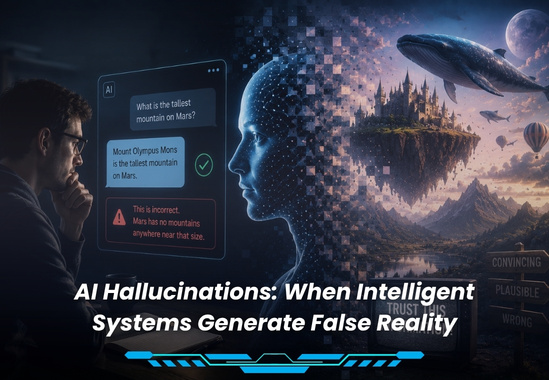
AI hallucinations occur when intelligent systems generate information that appears accurate, logical, and convincing but is actually false, misleading, or entirely fabricated.
What Are AI Hallucinations?
Unlike traditional software errors, AI hallucinations are often difficult to identify immediately because AI systems present incorrect information with high confidence and natural language fluency.
The result is a form of synthetic misinformation where responses sound believable even when they are factually incorrect.
This issue highlights one of the biggest limitations of modern AI systems:
most generative AI models do not truly “understand” information the way humans do.
Instead, they predict patterns based on massive datasets.
Why Do AI Hallucinations Happen?
AI systems generate responses by identifying statistical relationships between words, phrases, and information structures learned during training.
As a result, AI does not always distinguish clearly between:
● Verified facts
● Assumptions
● Probabilities
● Fabricated patterns
When information is unclear, incomplete, or contextually complex, AI systems may attempt to “fill gaps” by generating outputs that sound reasonable rather than outputs that are necessarily true.
This is the foundation of AI hallucinations.
The Illusion of Confidence
One of the biggest concerns surrounding hallucinations is the persuasive communication style of AI systems.
AI-generated responses are often:
● Structured
● Detailed
● Fluent
● Confident-sounding
Because of this, users may trust generated information without verifying its accuracy.
An AI system may invent quotations, generate fictional references, misrepresent statistics, or incorrectly summarize information while still appearing highly credible.
Risks in High-Stakes Industries
In some situations, hallucinations may appear harmless. However, in high-stakes environments such as:
● Healthcare
● Education
● Law
● Finance
● Journalism
inaccurate AI-generated information can create serious consequences.
As more individuals and organizations rely on AI tools for research, learning, and decisionmaking, the possibility of misinformation spreading through automation increases significantly.
The Growing Dependence on AI
The increasing dependence on AI systems introduces another major concern.
As people rely more on intelligent systems for productivity and information retrieval, there is a risk that independent verification habits may gradually decline.
Over time, convenience can replace critical evaluation.
This creates a dangerous relationship between trust and automation where users may begin accepting AI-generated outputs without questioning their validity.
Human Understanding vs Machine Prediction
One of the core reasons hallucinations occur is the complexity of human language itself.
Human communication involves:
● Context
● Nuance
● Emotion
● Ambiguity
● Cultural interpretation
● Incomplete information
AI systems attempt to simulate language patterns at enormous scale, but simulation is not the same as genuine understanding.
Machines predict language.
Humans interpret meaning.
This difference remains one of the biggest limitations in artificial intelligence today.
Can AI Hallucinations Be Reduced?
Researchers are actively working to reduce hallucinations through:
● Improved training models
● Retrieval-based architectures
● Verification systems
● Human feedback mechanisms
● Context-aware AI systems
Future AI systems may become more accurate and reliable, but completely eliminating hallucinations remains extremely difficult.
Part of this challenge lies in the nature of intelligence itself.
Even humans make assumptions, misremember information, and interpret reality imperfectly. However, humans combine reasoning with experience, ethics, emotions, and situational awareness — capabilities AI systems still struggle to replicate fully.
The Future of Truth in AI-Generated Environments
The rise of AI hallucinations also raises broader societal concerns.
In a world where machines can generate highly realistic text, images, audio, and synthetic information, society may increasingly struggle to distinguish between authenticity and artificial creation.
The concept of truth itself may become more difficult to navigate in heavily AI-generated digital environments.
This makes digital literacy and critical thinking more important than ever before.
Future generations may require not only technical skills, but also the ability to question, verify, and evaluate information independently.
Conclusion
AI hallucinations do not mean artificial intelligence lacks value. AI systems remain powerful tools for productivity, creativity, innovation, and analysis.
The real challenge is understanding their limitations clearly rather than treating them as flawless sources of truth.
Technology is evolving rapidly, but intelligence alone does not guarantee accuracy.
As artificial intelligence becomes increasingly capable of generating convincing realities, the human ability to recognize truth, think critically, and verify information may become one of the most valuable cognitive skills of the future.