




- :
- : 10-06-2026
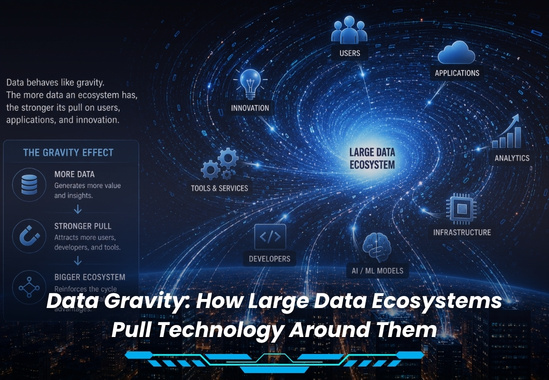
Data Gravity: How Large Data Ecosystems Pull Technology Around Them
As the digital world continues expanding, data is no longer just information stored inside systems. It has become a powerful force shaping how technology infrastructures are built, how businesses operate, and how modern digital ecosystems evolve.
This growing phenomenon is known as Data Gravity.
Data Gravity describes the tendency of large volumes of data to attract applications, services, systems, and additional data toward themselves. The larger a dataset becomes, the more difficult it becomes to move, manage, or separate from the surrounding infrastructure.
Much like gravity in physics pulls objects toward a central mass, large-scale data environments begin pulling technology ecosystems around them.
Understanding Data Gravity
Modern organizations generate enormous amounts of digital information every second:
● Customer interactions
● Analytics reports
● Financial records
● Cloud operations
● Smart devices
● Security logs
● Artificial intelligence systems
As this data continuously grows, organizations naturally begin building more applications, analytics tools, cloud services, and processing systems closer to where the data already exists.
Over time, the data itself becomes the center of the digital infrastructure.
This creates what experts refer to as Data Gravity.
Why Data Gravity Matters
Data Gravity is becoming increasingly important because modern businesses depend heavily on cloud computing, artificial intelligence, and large-scale analytics.
As datasets expand:
● Moving data becomes expensive
● Processing requires greater infrastructure
● System complexity increases
● Performance optimization becomes difficult
● Security risks become more significant
Large datasets begin influencing architectural decisions across entire organizations.
Instead of systems controlling data, data begins controlling how systems are designed.
The Relationship Between Cloud Computing and Data Gravity
Cloud platforms have accelerated the impact of Data Gravity.
Organizations today store massive amounts of information inside distributed cloud environments. As data accumulates in specific cloud infrastructures, businesses often continue building additional services within the same ecosystem because transferring large datasets elsewhere becomes inefficient.
This creates:
● Cloud dependency
● Infrastructure centralization
● Increased operational complexity
● Vendor lock-in risks
The more data grows, the stronger its gravitational pull becomes.
Data Gravity and Artificial Intelligence
Artificial intelligence systems rely heavily on large datasets for training, prediction, and automation.
The growth of AI has significantly increased the importance of Data Gravity because:
● AI models require continuous access to massive data volumes
● Real-time analytics depends on proximity to data
● Machine learning systems become more resource-intensive over time
As organizations expand AI capabilities, data ecosystems become even more concentrated and interconnected.
This further strengthens Data Gravity.
Hidden Challenges of Data Gravity
Infrastructure Complexity
Managing massive interconnected systems becomes increasingly difficult as data expands.
Reduced Flexibility
Organizations may struggle to migrate systems because moving large-scale data environments requires enormous resources.
Security Risks
Centralized data ecosystems become attractive targets for cyberattacks.
Performance Limitations
Large datasets create latency, processing bottlenecks, and scalability challenges.
Cost Escalation
Storage, processing, networking, and maintenance costs rise significantly as data ecosystems grow.
The Future of Data Gravity
As artificial intelligence, cloud computing, and connected technologies continue evolving, Data Gravity is expected to become one of the defining forces of digital infrastructure.
Future systems may require:
● Decentralized architectures
● Edge computing environments
● Distributed analytics systems
● Intelligent data placement strategies
● Real-time infrastructure optimization
Organizations that fail to manage Data Gravity effectively may face increasing operational inefficiencies and technological limitations.
Beyond Information Storage
Data Gravity shows that data is no longer passive information stored inside systems.
It is becoming an active force that influences:
● Infrastructure design
● Cloud strategy
● Artificial intelligence development
● Cybersecurity planning
● Digital transformation
In the modern technological era, the challenge is no longer simply collecting data.
The real challenge is managing the growing gravitational pull created by the data itself.