




- :
- : 15-06-2026
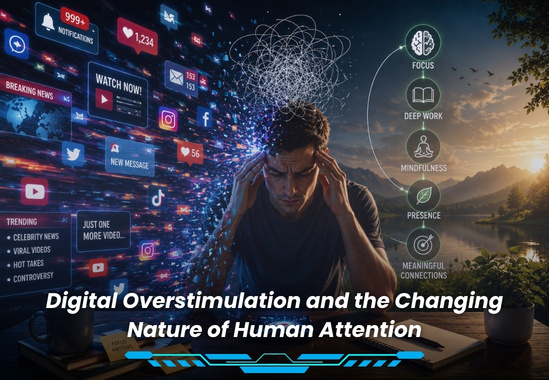
Digital Overstimulation and the Changing Nature of Human Attention
Introduction
There was a time when boredom was a natural part of everyday life. People waited quietly at bus stops, observed their surroundings during long journeys, sat silently between conversations, or simply allowed their minds to wander.
Today, those moments are becoming increasingly rare.
In the modern digital era, silence is often replaced instantly by scrolling, tapping, watching, or consuming online content. Smartphones, social media platforms, and digital entertainment systems have fundamentally changed how people interact with time, attention, and information.
The Rise of Continuous Digital Engagement
Modern digital platforms are designed to capture and retain attention continuously. Social media feeds refresh endlessly, short-form videos provide constant stimulation, and notifications interrupt even the smallest moments of inactivity.
As a result, people now spend far less time in mental stillness and far more time in uninterrupted engagement.
Technology has undoubtedly improved access to communication, information, and entertainment. However, the increasing dependence on constant stimulation raises an important question:
What happens when the human mind rarely gets time to pause?
The Psychological Importance of Boredom
Psychologists and researchers have long associated boredom with creativity, reflection, and problem-solving.
Moments of inactivity often allow the brain to:
● Process emotions
● Develop new ideas
● Strengthen imagination
● Reflect deeply
● Improve cognitive flexibility
Historically, many creative thoughts and innovations emerged during periods of silence and uninterrupted thinking rather than during continuous stimulation.
Boredom, in many ways, acts as mental recovery space.
The Attention Economy
Today’s digital ecosystem functions differently.
Applications and platforms compete aggressively for user attention through systems specifically designed to maximize engagement. These systems include:
● Infinite scrolling
● Autoplay videos
● Personalized recommendations
● Real-time notifications
● Short-form content formats
This structure is commonly referred to as the attention economy, where human focus itself becomes a valuable digital resource.
Algorithms continuously deliver new content before boredom can occur, reducing opportunities for mental stillness and reflection.
Effects on Attention and Focus
The impact of continuous digital stimulation is becoming increasingly visible, particularly among younger generations.
Many individuals now experience:
● Shortened attention spans
● Constant multitasking habits
● Difficulty concentrating for long periods
● Reduced tolerance for silence or inactivity
● Increased dependence on digital engagement
Even activities such as studying, reading, or maintaining uninterrupted conversations are increasingly challenged by frequent digital distractions.
Creativity in an Always-Connected World
The decline of boredom may also influence creativity and independent thinking.
When the mind remains constantly occupied, there is less opportunity for imagination to develop naturally. Instead of generating original thoughts independently, individuals often consume algorithmically selected streams of content.
As stimulation increases, deep reflection may gradually decrease.
This creates a digital culture where information is abundant, but uninterrupted thinking becomes increasingly rare.
Impact on Education and Learning
Educational environments are also being shaped by continuous digital engagement.
Students today grow up surrounded by:
● Instant information access
● Rapid content consumption
● Continuous notifications
● Short attention-driven media formats
Traditional learning methods that require patience, concentration, and long-form thinking are becoming more difficult to sustain within highly distracted digital environments.
This shift is encouraging educators and institutions to rethink how learning is structured in the digital age.
Technology and the Need for Balance
Technology itself is not inherently harmful.
Digital tools have transformed communication, healthcare, education, innovation, and global connectivity in remarkable ways. The challenge lies not in technology alone, but in the growing inability to disconnect from continuous stimulation.
The issue is ultimately one of balance:
● Connection and silence
● Speed and depth
● Engagement and reflection
Maintaining this balance may become increasingly important as digital systems continue to evolve.
Reconsidering the Value of Stillness
Ironically, boredom may still hold significant value in modern society.
Moments of stillness provide opportunities to:
● Think creatively
● Reflect independently
● Observe deeply
● Reconnect with personal thoughts
● Strengthen cognitive clarity
In a world driven by constant content consumption, the ability to pause and think without external stimulation may become one of the most important cognitive skills of the future.
Conclusion
Digital technology has successfully reduced boredom by creating environments of continuous stimulation and engagement. However, this transformation also raises important questions about attention, creativity, concentration, and mental well-being.
As society becomes increasingly connected, there may be a growing need to protect spaces for reflection, stillness, and deep thinking.
Because while technology has made information and entertainment instantly accessible, the disappearance of boredom may also reduce the mental space where imagination, creativity, and meaningful reflection once developed naturally.