


- :
- : 28-04-2026
Why do some systems give more relevant answers than others?
It’s not just about data—it’s about how that data is connected.
This is where Knowledge Graphs come in. They help systems understand relationships between information, not just store it.
For learners, this shows how modern technology is moving from isolated data to connected intelligence.
From Data Storage to Data Connections
Earlier, systems stored data in separate tables and formats.
While this made storage efficient, it made understanding relationships harder.
For example, linking people, places, and events required complex queries.
Today, systems are evolving to connect data in a more meaningful way, making it easier to understand and use.
What Are Knowledge Graphs?
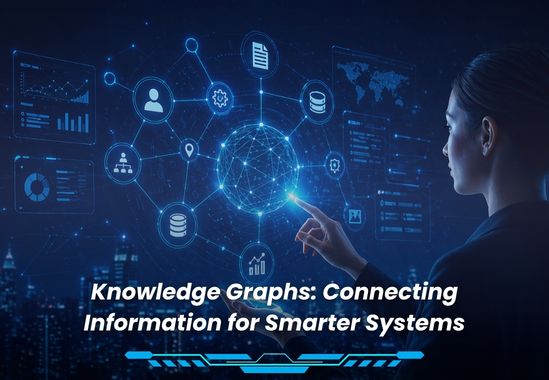
Knowledge Graphs are structures that connect different pieces of information based on their relationships.
Instead of storing data separately, they link it together.
In simple terms, they allow systems to:
Understand how data points are related
Organize information in a connected structure
Provide more meaningful and context-aware results
Where They Are Used
Knowledge Graphs are used in many modern digital systems:
Search Systems
Providing more relevant and connected search results.
Recommendation Platforms
Suggesting content based on relationships between user preferences.
Digital Assistants
Understanding context and improving responses.
Enterprise Systems
Organizing large amounts of structured and unstructured data.
These applications show how connected data improves system intelligence.
Why It Matters
Knowledge Graphs help systems:
Improve accuracy of results
Understand context better
Connect information across different sources
Support smarter decision-making
They move systems from simply storing data to understanding it.
What This Means for Students
For students, Knowledge Graphs highlight how modern systems are designed to work with complex data.
They introduce concepts such as:
Data relationships
Structured and connected data
Context-based systems
Information modeling
Understanding these ideas helps learners see how advanced digital systems deliver meaningful insights.
Looking Ahead
As data continues to grow, the ability to connect and interpret information will become increasingly important.
Knowledge Graphs will play a key role in building systems that are more intelligent, context-aware, and efficient.
For learners, this is an opportunity to understand how future systems will move beyond data storage toward data understanding.
R-CAT Alignment
As data-driven technologies continue to evolve, understanding how information is structured and connected becomes increasingly important for learners.
Through its continued focus on technology-enabled education and advanced skill development, R-CAT supports students in building data awareness, understanding modern system architectures, and preparing for participation in evolving digital ecosystems.