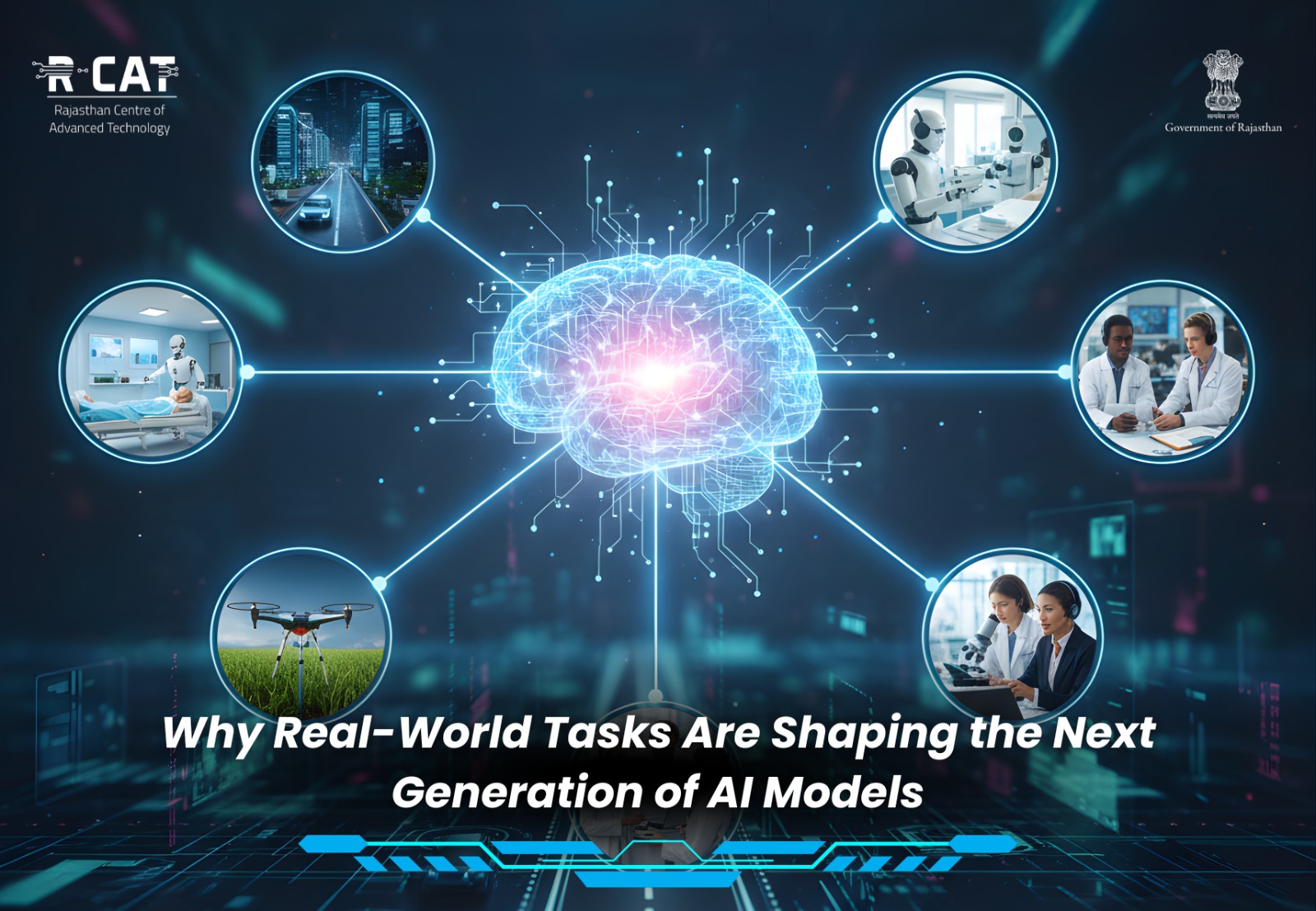





- :
- : 06-01-2026
Introduction: The Changing Direction of Artificial Intelligence
Artificial Intelligence (AI) has moved beyond controlled experiments and theoretical benchmarks. While early AI models focused mainly on accuracy within limited datasets, modern systems are increasingly evaluated on how well they perform real-world tasks. These tasks reflect real conditions, including incomplete data, unpredictable inputs, and ethical considerations.
This shift marks an important stage in AI development. It emphasizes not only what AI models can calculate, but also how effectively they can operate in practical environments. For students and emerging professionals, this change highlights the growing importance of applied learning and real-world exposure in AI education.
Understanding Real-World Tasks in AI
Real-world tasks in AI refer to practical problems that occur in everyday settings rather than idealized environments.
Common Characteristics of Real-World Tasks
● Data is often unstructured or inconsistent
● Problems evolve over time
● Decisions may affect people, systems, or public services
● Ethical and social factors must be considered
Examples include language processing, automated decision support, digital service delivery, and data-driven governance. These tasks require AI systems to function reliably beyond controlled laboratory conditions.
Limitations of Traditional AI Development Approaches
Earlier approaches to AI development focused heavily on:
● Clean and well-labeled datasets
● Fixed objectives
● Isolated testing environments
While these methods were useful for foundational learning, they often failed when models were deployed in real situations. Many systems struggled to adapt to new inputs or unexpected scenarios.
As a result, AI research has shifted toward training and evaluating models using realistic, task-based frameworks that better represent actual use cases.
How Real-World Tasks Improve AI Model Design
Improved Adaptability
Exposure to real-world tasks helps AI systems learn to handle variation and uncertainty, making them more adaptable across different conditions.
Meaningful Performance Evaluation
Instead of focusing only on accuracy scores, models are assessed on usability, reliability, and long-term performance.
Human-Centered Outcomes
Real-world tasks encourage the design of AI systems that interact effectively with people, supporting trust and transparency.
Skills Required for Working on Real-World AI Tasks
The focus on real-world tasks has changed the skill expectations for AI professionals.
Technical Skills
● Data preparation and validation
● Model testing under real conditions
● Understanding system limitations
Analytical and Ethical Skills
● Problem definition
● Awareness of bias and fairness
● Responsible use of AI technologies
Students who develop both technical and analytical skills are better prepared to contribute meaningfully to AI-driven projects.
Responsible AI and Real-World Applications
When AI systems are used in real environments, responsibility becomes essential. Models must be:
● Transparent in how decisions are made
● Secure and reliable
● Designed with ethical safeguards
Real-world task-based development helps identify potential risks early and supports the creation of AI systems that serve the public interest.
Learning AI Through Practical Engagement
The next generation of AI models is being shaped by real-world tasks that demand adaptability, responsibility, and meaningful impact. This shift reflects a broader understanding of AI as a practical tool rather than a purely theoretical system.
For students and professionals, aligning education with real-world challenges creates stronger foundations for future work. Institutions involved in advanced technology and skill development play a supportive role in enabling this applied approach.
Learners seeking exposure to applied AI practices may explore government-supported technology and training ecosystems, such as R-CAT, to gain a deeper understanding of real-world implementation.